Showing posts with label Largest. Show all posts

Wednesday, May 25, 2016

Top 10 Largest Islands In The World

Top 10 Largest Islands In The World
An island/isle is any piece of sub-continental land that is surrounded by water. Very small islands such as emergent land features on atolls can be called islets, skerries, cays or keys. The exact number of Islands on Earth can be a difficult process. It is said to be, there are around 2000 Islands in the oceans. These Islands vary in size, geography, climate, flora and fauna. Here in this article Top 10 Largest Islands listed, Read on:


Top 10 Largest Islands In The World

1. Greenland 2,130,800 square kilometers
1. Greenland, 2,130,800 square kilometers
Greenland is an autonomous country within the Danish Realm, located between the Arctic and Atlantic Oceans, east of the Canadian Arctic Archipelago. Greenland is the world's largest island with a total area of 2,130,800 square kilometers. With a population of about 56,480 (2013), it is the least densely populated country in the world. Greenland is an Island and not a continent. The Greenland is home to second largest ice sheets in the world just behind the Antarctica; over three-quarters of which is covered by the only permanent ice sheet outside of Antarctica. Sealing, whaling and fishing are the main source of income for the people of Greenland.

2. New Guinea 785,753 square kilometers
New Guinea is a large Island in the South West Pacific region.  It is the world's second-largest island after Greenland. New Guinea covers a land area of 785,753 km2, and it is not the largest wholly within the southern hemisphere. The island is divided among two countries: Papua New Guinea to the east, and Indonesia to the west. The New Guinea Island is dominated by high mountains. At an altitude of 16503 ft the Jaya peak is the highest point in the New Guinea Island. The humans have been settled on the New Guinea Island over 40000 years ago. The New Guinea Island has large deposits of copper and gold.

3. Borneo 748,168 square kilometers
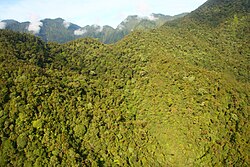
Borneo is the third-largest island in the world and the largest island in Asia. At the geographic center of Maritime Southeast Asia, in relation to major Indonesian islands, it is located north of Java, west of Sulawesi, and east of Sumatra. Antipodal to an area of Amazon rainforest, Borneo is itself home to one of the oldest rainforests in the world. The rainforests of Borneo has been aged more than 130 million years. It is the oldest rainforest in the world. These forests are also home to 15000 species of plants, 221 species of mammals and 420 species of birds. The mount kimabalu, the highest peak in Southeast Asia is located in the Borneo Island.

4. Madagascar 587,713 square kilometers
Madagascar officially the Republic of Madagascar is an island country in the Indian Ocean, off the coast of Southeast Africa it is the fourth-largest island in the world. Madagascar split from the Indian peninsula around 88 million years ago, allowing native plants and animals to evolve in relative isolation. Consequently, Madagascar is a biodiversity hotspot; There are 14000 different species of plants; 90% of its wildlife is found nowhere else on Earth; Madagascar is home to 250000 species of animals 70% of them are found nowhere else in the world. The island's diverse ecosystems and unique wildlife are threatened by the encroachment of the rapidly growing human population and other environmental threats. The Toliara coral reef in the Southwestern Madagascar is the third largest coral system in the world.

5. Baffin Island 507,451 square kilometers
 5. Baffin Island 507,451 square kilometers
Baffin Island in the Canadian territory of Nunavut, is the largest island in Canada and the fifth largest island in the world. Its area is 507,451 km2 and its population is about 11,000 (2007). Named after English explorer William Baffin. Baffin Island can offer you to see stunning displays of Northern Lights, as most parts of the Baffin Island lies North of the Arctic circle. A large number of mammals, including polar bears, Arctic wolves and lemmings are live in the Baffin Island. There are two National Parks in the Baffin Island: Sirmilik and Auyuittuq. These National Parks are home to spectacular glaciers, majestic Fjords and snow fields.

6. Sumatra 480,848 square kilometers
Sumatra is an island in western Indonesia and part of the Sunda Islands. It is the largest island that is entirely in Indonesia and the sixth largest island in the world at 473,481 km2. It is also the Westernmost Island of Indonesian archipelago. The Sumatra Island is prone to powerful earthquakes and Tsunamis. It is because this Island is located at the subduction zone of Indo-Australian and Eurasian tectonic plates. However, the Sumatra Island is home to amazing wildlife and rich forests. The most part of the Sumatra Island is covered by tropical rainforests; it is the home to some of critically endangered species; Sumatran tiger, orangutan, Rhinoceros, ground-cuckoo; Rafflesia arnodii. The Sumatra Island contains large deposits of gold and silver. Some of the finest oil plants and coal-fields are also located in the Island of Sumatra.

7. Honshu 225,800 square kilometers
 7. Honshu 225,800 square kilometers
Honshu is the largest and most populous island of Japan. The island separates the Sea of Japan, which lies to its north and west, from the North Pacific Ocean to its south and east. It is the seventh largest island in the world, and the second most populous after Java. Honshu had a population of 103 million as of 2005. This Island is 800 miles long, 150 miles wide with an area of 225,800 square kilometers. That is around 60% of the total size of Japan. The Honshu Island is home to some of the important cities of Japan, including Tokyo, Kyoto, Hiroshima, Yokohama and Osaka. The largest mountain in Japan, the Mount Fuji located in this Island. The Honshu Island also contains the largest lake of Japan, the Lake Biwa.

8. Victoria Island 217,291 square kilometers
Victoria Island is an island in the Canadian Arctic Archipelago and straddles the boundary between Nunavut and the Northwest Territories of Canada. It is the eighth largest island in the world, and at 217,291 km2 is Canada's second largest island. It contains the world's largest island within an island within an island. The Island was discovered by the Arctic explorer Thomas Simpson in 1838. As of 2006, 1875 people live in this large Island; The Northwest part of the Victoria Island contain 15 mile wide Tunnunik impact crater. It is said to be formed between 130 and 350 million years ago by a meteorite.

9. Great Britain 209,331 square kilometers
9. Great Britain 209331 square kilometers
Great Britain is the largest island in Europe and the ninth-largest in the world; with an area of 209,331 km2, it. In 2011 the island had a population of about 61 million people, making it the third-most populous island in the world, after Java in Indonesia and Honshu in Japan; The human habitation in the Great Britain has been started 500000 years ago. The island is the largest in the British Isles archipelago, which also includes the island of Ireland to its west and over 1,000 smaller surrounding islands. The Great Britain is the most populous region in Europe. The Great Britain receives a pleasant, mild temperature throughout the year. London is the largest city in the Great Britain.

10. Ellesmere Island 196,236 square kilometers
Ellesmere Island is part of the Qikiqtaaluk Region of the Canadian territory of Nunavut. Lying within the Canadian Arctic Archipelago, it is considered part of the Queen Elizabeth Islands, with Cape Columbia being the most northerly point of land in Canada. It comprises an area of 196,235 km2 and the total length of the island is 830 kilometres making it the world's tenth largest island and Canada's third largest island. The Arctic Cordillera mountain system covers much of Ellesmere Island, making it the most mountainous in the Canadian Arctic Archipelago. The Arctic willow is the only woody species to grow on Ellesmere Island.      A chain of sedimentary rocks located in the Northern parts of the Ellesmere Island aged more than 100000 years. The Ellesmere Island contains remnants of the last ice age. The first human inhabitants of Ellesmere Island were small bands drawn to the area for Peary caribou, muskox, and marine mammal hunting about 2000–1000 BCE.

So what you think about this list don't forget to mention :)

Sunday, May 8, 2016

Top 10 Largest Hindu Temples In The World

Top 10 Largest Hindu Temples In The World
A Hindu temple (Sanskrit is what there holy book is written intraditions. A temple incorporates all elements of Hindu cosmos - presenting the good, the evil and the human, as well as the elements of Hindu sense of cyclic time and the essence of life - symbolically presenting dharma, kama, artha, moksa and karma) The primary goal of every Hindu temple is enlightenment. The architectural styles, towering gopuras, magnificent sculptures, images, carvings and decorations of temple bring a high positive energy. There are a lot's of largest Hindu temple exists around the world, and Here is the list of largest Hindu temples in the world. Read on:

Top 10 Largest Hindu Temples In The World

1. Angkor Wat
1. Angkor Wat
Angkor Wat is a temple complex in Cambodia and the largest religious monument in the world, with the site measuring 162.6 hectares (1,626,000 sq meters). It was originally constructed as a Hindu temple for the Khmer Empire, gradually transforming into a Buddhist temple toward the end of the 12th century. It was built by the Khmer King Suryavarman II in the early 12th century in Yaśodharapura, the capital of the Khmer Empire, as his state temple and eventual mausoleum. Stretching over 500 acres the Angkor Wat temple in Cambodia is the largest religious structure in the world. It is a UNESCO world heritage site and icon of Cambodia. The center tower of the temple stands at a height of 65 meters is surrounded by four smaller towers.  The main entrance of the Angkor Wat on West side has rich decorations with sculptures and carvings. There is also a 3.2 meters high statue of Lord Vishnu made of sandstone. The central complex of Angkor Wat is a three storey structure.There are three main galleries in the central complex of the temple. Each gallery also has a lotus-bud shaped tower. The gallery of thousands Buddha houses hundreds of images of Lord Buddha. The inner wall of Angkor Wat is also decorated with important scenes from Hindu epics Ramayana and Mahabharata.

2. Ranganathaswamy Temple
2. Ranganathaswamy Temple, Srirangam
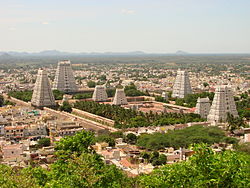
The Sri Ranganathaswamy Temple is a Hindu temple dedicated to Ranganatha, a reclining form of Hindu deity, Vishnu located in Srirangam, Tiruchirapalli, Tamil Nadu, India. Constructed in the Dravidian style of architecture, this temple is glorified in the Thiviya Pirabandham, the early medieval Tamil literature canon of the Alvar saints from the 6th to 9th centuries AD and is counted among the 108 Divya Desams dedicated to Vishnu. The temple follows Thenkalai tradition of worship. Sri Ranganathaswamy temple is the most famous and largest Hindu temple in India. This magnificent Vishnu temple is also one of the finest Dravidian religious structures in India. The inscriptions from Sri Ranganathaswamy temple describe the role of Different dynasties including Chola, Pandya, Hoysala and Vijayanagar in the restoration and renovation of the temple. There are 21 towers and 39 pavilions in Sri Ranganathaswamy Temple. At height of 236 feet main gopura of the temple known as Rajagopuram is the second tallest temple tower in Asian continent. The temple comprises seven enclosures formed by thick walls. The rampart wall encircles the golden plated main sanctum of the temple. The inner five prakaras as function as temple and the Non-Hindus are not allowed to enter main sanctum of the temple.

3. Akshardham Temple
3. Akshardham
Akshardham or Swaminarayan Akshardham complex is a Hindu mandir, and a spiritual cultural campus in New Delhi, India. The complex displays millennia of traditional Hindu and Indian culture, spirituality, and architecture. Hindu temple after the Akshardham in Gandhinagar both inspired and developed by Pramukh Swami Maharaj, the spiritual head of the Bochasanwasi Shri Akshar Purushottam Swaminarayan Sanstha, whose 3,000 volunteers helped 7,000 artisans construct the temple. The Akshardham temple complex is entirely made of sandstone and marble. The magnificent gajendra pith of the temple symbolizing the animal kingdom. It features 148 full sized elephants, 42 birds and 125 human sculptures carved in pink stone.  The 1070 feet long gajendra pith also represents a deep relation of ancestors of India and with nature. The main monument of Akshardham temple consists of 234 carved pillars and nine domes. The carvings of detailed information about Hindu deities, plants, animals and arts also can be found inside the monument.

4. Belur Math Temple
4. Belur Math
Belūr Maṭh or Belur Mutt is the headquarters of the Ramakrishna Math and Mission, founded by Swami Vivekananda in 1897, a chief disciple of Ramakrishna Paramahamsa. It is located on the west bank of Hooghly River, Belur, West Bengal, India and is one of the significant institutions in Calcutta. This temple is the heart of the Ramakrishna Movement. The temple is notable for its architecture that fuses Hindu, Christian and Islamic motifs as a symbol of unity of all religions. The most interesting feature of Belur math is it look like a temple, church or a mosque from every angle.“The spiritual light that this place will emit will flood the whole universe” Swami Vivekananda said on the occasion of  laying the foundation stone of Belur Math in 1898. The entire complex of Belur math covers an area of 40 acres. The Belur Math complex contains temples dedicated for Sri Ramakrishna, Swami Vivekananda and Holy mother, Sri Sarada Devi. The main gate of the temple contains symbols of different religions. The museum of the Belur math also contains different artifacts used by Sri Ramakrisha and Swami Vivekananda.

5. Thillai Nataraja Temple
Thillai Natarajah Temple, Chidambaram or Chidambaram temple is a Hindu temple dedicated to Lord Shiva located in the town of Chidambaram, East-Central Tamil Nadu, South India. The temple is known as the foremost of all temples to Saivites and has influenced worship, architecture, sculpture and performance art for over two millennium. The Sangam classics list chief architect Viduvelvidugu Perumthachchan as directing an early renovation of the shrine. The historic Hindu temple spread across 50 acres. The sanctum also contains images of Lord Shiva and Goddess Parvathy. The temple was renovated by rulers of different dynasties including Pallava, Chola, Pandya, Vijayanagara and Chera in different period of time. According to the hypothetical believes the Nadaraja temple is located in the lotus of the universe known as ‘virat hridhaya padhma sthanam’. There are four main gopuras standing at a height of 250 feet and face four different directions. The magnificent towers are also decorated with 108 different poses of Bharata Natya and with images of Hindu mythology.

6. Prambanan Temple
6. Prambanan
Candi Prambanan or Candi Rara Jonggrang is a 9th-century Hindu temple compound in Central Java, Indonesia, dedicated to the Trimurti, the expression of God as the Creator (Brahma), the Preserver (Vishnu) and the Destroyer (Shiva). The temple compound, a UNESCO World Heritage Site, is the largest Hindu temple site in Indonesia, and one of the biggest in Southeast Asia. It is characterized by its tall and pointed architecture, typical of Hindu temple architecture, and by the towering 47-metre-high (154 ft) central building inside a large complex of individual temples. Prambanan attracts many visitors from around the world. The Prambanan compound also known as Rara Jonggrang complex, named after the popular legend of Rara Jonggrang. There were once 240 temples stood in this Shivaite temple complex, either big or small. Today, all of 8 main temples and 8 small shrines in inner zone are reconstructed, but only 2 out of the original 224 pervara temples are renovated. The majority of them have deteriorated; what is left are only scattered stones.

7. Brihadeeswarar Temple
Brihadeeswarar Temple locally Known as Tanjai Periya Kovil is a Hindu temple dedicated to Shiva located in Thanjavur in the Indian state of Tamil Nadu. It is one of the largest temples in India and is an example of Tamizh architecture during the Chola period. Built for Raja Raja Chola I and completed in 1010 CE, the temple turned 1000 years old in 2010.The architect and engineer of the temple, Kunjara Mallan Raja Raja Perumthachan is revered today as a father figure to all craftsmen in his homeland of present-day Central Kerala. The temple is part of the UNESCO World Heritage Site known as the "Great Living Chola Temples". The temple stands amidst fortified walls that were probably added in the 16th century. The vimanam is 100 ft (30 m) high and is the tallest in the world. There is a big statue of Nandi (sacred bull), carved out of a single rock measuring about 16 ft long and 13 ft high at the entrance. The entire temple structure is made out of granite, the nearest sources of which are about 60 km to the west of temple. It is the world's 1st complete "granite" temple. The temple is one of the most visited tourist attractions in Tamil Nadu.

8. Annamalaiyar Temple

8. Annamalaiyar Temple
Annamalaiyar Temple is a Hindu temple dedicated to the deity Shiva, located at the base of Annamalai hills in the town of Thiruvannamalai in Tamil Nadu, India. It is significant to the Hindu sect of Saivism as one of the temples associated with the five elements, the Pancha Bhoota Stalas, and specifically the element of fire, or Agni. Shiva is worshiped as Annamalaiyar or Arunachaleswarar, and is represented by the lingam. The presiding deity is revered in the 7th century Tamil Saiva canonical work, the Tevaram, written by Tamil saint poets known as the nayanars and classified as Paadal Petra Sthalam. The 9th century Saiva saint poet Manikkavasagar composed the Tiruvempaavai here.  The temple complex covers 10 hectares, and is one of the largest in India. It houses four gateway towers known as gopurams. The tallest is the eastern tower, with 11 stories and a height of 66 metres, making it one of the tallest temple towers in India. The temple has numerous shrines, with those of Annamalaiyar and Unnamulai Amman being the most prominent. The temple complex houses many halls; the most notable is the thousand-pillared hall built during the Vijayanagar period.

9. Rajagopalaswamy Temple
Rajagopalaswamy temple is a Vaishnavite shrine located in the town of Mannargudi, Tamil Nadu, India. The presiding deity is Rajagopalaswamy, a form of Lord Krishna. The temple is spread over an area of 23 acres (93,000 m2) and is one of the important Vaishnavite shrines in India. The temple is called Dakshina Dwarka (Southern Dwarka) along with Guruvayoor by Hindus. The image of the presiding deity is 156 Feet tall. There is a big tank at the entrance of the shrine where rain water is collected. The temple complex has 16 gopurams (tower gateways), 7 prakarams (outer courtyard), 24 shrines, seven mandapams (halls) and nine sacred theerthams (temple tanks). The utsava (festival deity) is a bronze figure from the Chola period. It shows keshabanda type of coifure and restrained ornamentation, atypical of the Chola bronzes of the 11th century. The temple tank is called Haridra Nadhi, 1,158 feet long and 837 feet broad (23 acers), making it one of the largest temple tanks in India.

10. Ekambareswarar Temple
Ekambaranathar Temple or Ekambareswarar Temple is a Hindu temple dedicated to Shiva, located in Kanchipuram in the state of Tamil Nadu, India. The temple is the largest temple in the town of Kanchipuram and is located in the northern part of the town. The temple gopuram (gateway tower) is 59m tall, which is one of the tallest gopurams in India. It is one of the five major Shiva temples or Pancha Bootha Sthalams (each representing a natural element) representing the element - Earth. The other four temples in this category are Thiruvanaikaval Jambukeswara (water), Chidambaram Natarajar (Sky), Thiruvannamalai Arunachaleswara (fire) and Kalahasti Nathar (wind). It is one of the 275 Paadal Petra Sthalams, where all of the four most revered Nayanars (Saivite Saints) have sung the glories of this temple. The temple is one of the most prominent tourist attractions in the city.

So what you think about this list don't forget to mention :)

Sunday, April 10, 2016

Top 10 Largest Snake in the world

Top 10 Largest Snake in the world
Snakes are elongated, legless, carnivorous reptiles of the suborder Serpentes that can be distinguished from legless lizards by their lack of eyelids and external ears. Like all squamates, snakes are ectothermic, amniote vertebrates covered in overlapping scales. Many species of snakes have skulls with several more joints than their lizard ancestors, enabling them to swallow prey much larger than their heads with their highly mobile jaws. To accommodate their narrow bodies, snakes' paired organs appear one in front of the other instead of side by side, and most have only one functional lung. Some species retain a pelvic girdle with a pair of vestigial claws on either side of the cloaca. The largest living snakes in the world, measured either by length or by weight, are various members of the boidae and pythonidae families. They include anacondas, pythons, and boa constrictors, which are all non-venomous constrictors. Here in this article Top 10 Largest Snake in the world written, Read on:

Top 10 Largest Snake in the world

1. The Green anaconda (29 ft.)
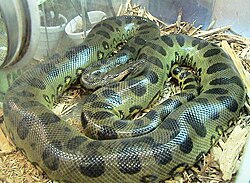
Green anaconda
The green anaconda (Eunectes murinus), also known as the common anaconda and water boa, is a non-venomous boa species found in South America. It is the heaviest and one of the longest known extant snake species. The term anaconda often refers to this species, though the term could also apply to other members of the genus Eunectes. They may exceed 227 kg (500 lb), validity questionable 97.5 kg (215 lb) maximum among 780 specimens caught over a seven-year period 1992–1998 Average 30.8 kg (68 lb) among 45 specimens (1992–1998). With an average length of 6 m (20 ft.) and a top length of 8.8 m (29 ft.) the green anaconda is one of the longest snakes in the world. The green anaconda, with a girth of nearly 30 cm (12 in.)

2. The reticulated python (25.2 ft)
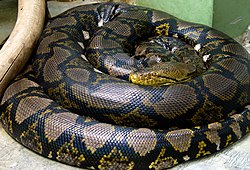
reticulated python
The reticulated python (Python reticulatus) is a species of python found in Southeast Asia. It is widely regarded as the world's longest snake and longest reptile, but is not the most heavily built (although it is among the four heaviest). Like all pythons, it is a nonvenomous constrictor and normally not considered dangerous to humans. Although large specimens are powerful enough to kill an adult human, attacks are only occasionally reported. 10 m (33 ft), not firmly verified 7.9 m (26 ft), reasonably reliable, for "Samantha" in 2002, 7.67 m (25.2 ft), somewhat reliable, for "Medusa" in 2011.

3. The African rock python (24 ft)

African rock python

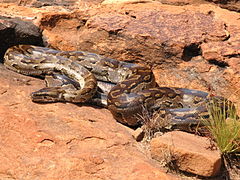
The African rock python (Python sebae) is a large, nonvenomous snake of sub-Saharan Africa. It is one of 11 living species in the genus Python. It has two subspecies; one is found in Central and Western Africa, the other in Southern Africa.  Africa's largest snake and one of the six largest snake species in the world (along with the green anaconda, reticulated python, Burmese python, Indian python, and amethystine python), specimens may approach or exceed 6 m (20 ft)and maximum Length: up to 7.5 m. The snake is found in a variety of habitats, from forests to near deserts, although usually near sources of water. The African rock python kills its prey by constriction and often eats animals up to the size of antelope, occasionally even crocodiles. They can weight Up to 113 kg (250 lb).

4. The Burmese python (22 ft)
Burmese python
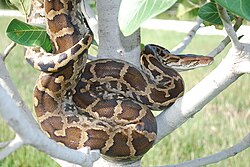
The Burmese python (Python bivittatus) is one of the five largest species of snakes in the world (about the third-largest as measured either by length or weight). It is native to a large variation of tropic and subtropic areas of South and Southeast Asia. Until 2009, it was considered a subspecies of Python molurus, but now is recognized as belonging to a distinct species.They are often found near water and are sometimes semi-aquatic, but can also be found in trees. The Burmese python is the largest subspecies of the Indian python, Lengths of more than 15 feet (4.6 m) are common, and they may exceed 22 feet (6.7 m) in captivity, however the average is about 16 feet (4.9 m) in length.

5. The Indian python (21 ft)
Indian python
The Indian python/Python molurus is a large nonvenomous python species found in many tropic and subtropic areas of South Asia and Southeast Asia. It is known by the common names Indian python, black-tailed python and Indian rock python. The species is limited to Southern Asia. It is generally lighter colored than the Burmese python and reaches usually 3 metres (9.8 ft). Indian pythons, P. molurus molurus, stays smaller, reaching a maximum of about 6.4 m (21 ft) in length, and weighing as much as 91 kg (200 lbs.).

6. The Amethystine scrub python (20 ft) 
Amethystine scrub python
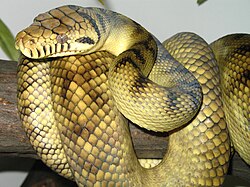
The Amethystine (scrub) python/Morelia amethistina is a non-venomous species of snake, known as the amethystine, scrub python or Sanca permata locally, found in Indonesia, Papua New Guinea and Australia. Popular among reptile enthusiasts, and noted for its coloration and size, it is one of the six largest snakes in the world, as measured either by length or weight, and is the largest native snake in Australia and Papua New Guinea. Weight up to 90 kg (200 lb) and length In excess of 6 m (20 ft) Typically 3.5 m (11 ft) Minimum adult length 1.8 m (5.9 ft).

7. The Apodora (17 ft)
Apodora
The Apodora is a monotypic genus created for the non-venomous python species, A. papuana, found in New Guinea. No subspecies are currently recognized. Adults growing to lengths of over 5 m (17 feet). However, they are not nearly as heavy bodied as other pythons, weighing in at no more than about 22.5 kg (50 lb). They are noted for having the ability to change color, though the exact mechanism and reasons for it are not completely understood. The color is reputed to change when the snake is agitated.

8. The yellow anaconda (15.1 ft)
 yellow anaconda
The yellow anaconda (Eunectes notaeus) is a boa species endemic to South America. It is one of the largest snakes in the world, but is not as large as its close relative, the green anaconda. Like all boas and pythons, it is non-venomous and kills its prey by constriction. The yellow anaconda is found in southern regions of South America, including Paraguay, southern Brazil, northeastern Argentina, and Bolivia. They nevertheless grow to an average of 3.3 to 4.4 m (10.8 to 14.4 ft) in total length. They commonly weigh 25 to 35 kg, though large specimens can weigh 40 to 55 kg or even more. The maximum size can certainly be larger, although confusion with its larger cousin may complicate matters. Female yellow anacondas have reportedly been measured up to 4.6 m (15.1 ft).

9. The black mamba (14.8ft)
black mamba
The black mamba (Dendroaspis polylepis) is a venomous snake endemic to sub-Saharan Africa. It takes its common name not from the color of its scales, but from the interior of its mouth, which is inky-black. It is the longest species of venomous snake on the African continent, with a length typically ranging from 2 meters (6.6 ft) to 3 meters (9.8 ft) and up to 4.3 to 4.5 meters (14.1 to 14.8 ft). It is among the fastest-moving snakes in the world, capable of moving at 11 km/h (6.8 mph) over short distances.


10. The boa constrictor (13 ft)
 boa constrictor
The boa constrictor or red-tailed boa (Boa constrictor) is a species of large, heavy-bodied snake. It is a member of the family Boidae found in North, Central, and South America, as well as some islands in the Caribbean. A staple of private collections and public displays, its color pattern is highly variable yet distinctive. Ten subspecies are currently recognized, although some of these are controversial. Weights up to More than 45 kg (99 lb), Length Possibly up to 4 m (13 ft).

So What you think about this list don't forget to mention :)

Saturday, April 9, 2016

Top 10 Largest libraries in the World

Top 10 Largest libraries in the World
Library is a collection of sources of information and similar resources, made accessible to a defined community for reference or borrowing. Library provides physical or digital access to material, and may be a physical building or room, or a virtual space, or both. A library's collection can include books, periodicals, newspapers, manuscripts, films, maps, prints, documents, micro-form, CDs, cassettes, videotapes, DVDs, Blu-ray Discs, e-books, audiobooks, databases, and other formats. Libraries range in size from a few shelves of books to several million items. Here below Top 10 Largest libraries in the World given, read on:

Top 10 Largest libraries in the World

1. The Library of Congress
 Library of Congress
The Library of Congress is the research library that officially serves the United States Congress, but which is the national library of the United States. It is the oldest federal cultural institution in the United States. The Library is housed in three buildings on Capitol Hill in Washington, D.C., and also maintains the Packard Campus in Culpeper, Virginia, which houses the National Audio-Visual Conservation Center. The library is the largest library in the world by collection size, with the second largest being the British Library. The Library's "collections are universal, not limited by subject, format, or national boundary, and include research materials from all parts of the world and in more than 450 languages, It was founded in 1800. This library stocks over 30 million books. Two-thirds of the books it acquires each year are in languages other than English." Cataloged Size (number of items) 160 million+, Visitors per year 1.75 million.

2. The British Library
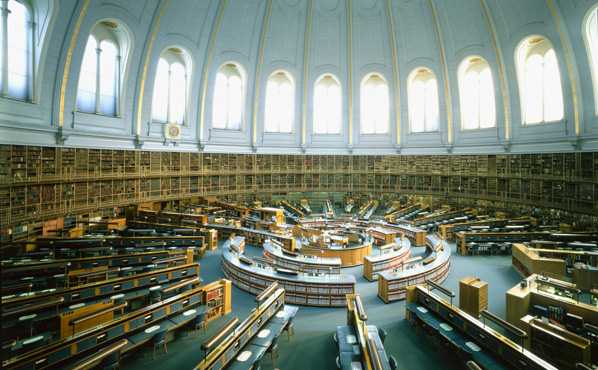
The British Library is the national library of the United Kingdom and the second largest library in the world by number of items cataloged. A Grade I listed building, the library is a major research library, holding around 170 million items from many countries, in many languages and in many formats, both print and digital: books, manuscripts, journals, newspapers, magazines, sound and music recordings, videos, play-scripts, patents, databases, maps, stamps, prints, drawings. The Library's collections include around 14 million books, along with substantial holdings of manuscripts and historical items dating back as far as 2000 BC. Established 1973 (1753) and Location is 96, Euston Road, London, NW1 2DB. Cataloged Size (number of items) 150 million+, Visitors per year 1.75 million.

3. The Library and Archives Canada
The Library and Archives Canada (LAC) is a federal institution tasked with acquiring, preserving and making Canada's documentary heritage accessible. LAC reports to Parliament through Mélanie Joly, the Minister of Canadian Heritage since November 4, 2015.  LAC's holdings include the archival records of the Government of Canada, representative private archives, 20 million books acquired largely through legal deposit, 24 million photographs, and more than a petabyte of digital content. Some of this content, primarily the book collection, university theses and census material, is available online. Many items have not been digitized and are only available in physical form. National Library of Canada is in Ottawa, Canada. It was founded in 1953. Cataloged Size (number of items) 54 million+.

4. The New York Public Library
The New York Public Library (NYPL) is a public library system in New York City. With nearly 53 million items, the New York Public Library is the second largest public library in the United States (behind the Library of Congress), and fourth largest in the world. It is an independently managed, nonprofit corporation operating with both private and public financing. It was founded in 1895. This library stocks over 11 million books. The library has branches in the boroughs of Manhattan, The Bronx, and Staten Island, and affiliations with academic and professional libraries in the metropolitan area of New York State. Cataloged Size (number of items) 53 million+, Visitors per year 18 million.

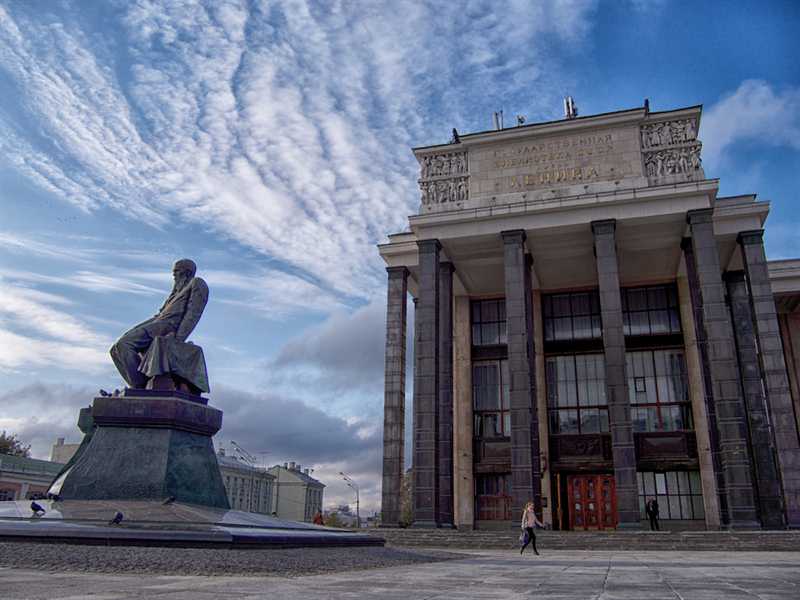
5. The Russian State Library 
Russian State Library
The Russian State Library is the national library of Russia, located in Moscow. It is the largest in the country and the fourth largest in the world for its collection of books (17.5 million). It was named the V. I. Lenin State Library of the USSR from 1925 until it was renamed in 1992 as the Russian State Library.  The library has over 275 km of shelves with more than 43 million items, including over 17 million books and serial volumes, 13 million journals, 350 thousand music scores and sound records, 150,000 maps and others. There are items in 247 languages of the world, the foreign part representing about 29 percent of the entire collection. Visitors per year 1.17 million.

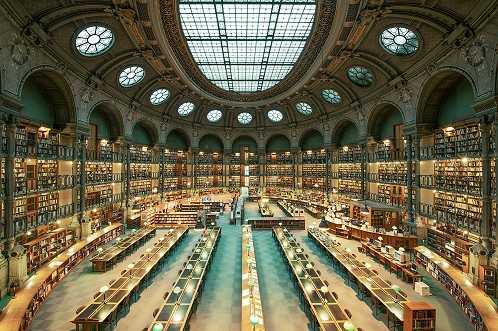
6. The Bibliothèque nationale de France
The Bibliothèque nationale de France
The Bibliothèque nationale de France (BnF) is the National Library of France, located in Paris. It is intended to be the repository of all that is published in France. The current president of the library is Bruno Racine. Established 1461 years ago, Items collected books, journals, newspapers, magazines, sound and music recordings, patents, databases, maps, stamps, prints, drawings and manuscripts Size 40 million items 14 million books and publications. Cataloged Size (number of items) 40 million+, Visitors per year 1.3 million.

7. The National Library of Russia 
 National Library of Russia
The National Library of Russia in St Petersburg (NLR). The NLR is currently ranked among the world’s major libraries. It has the second richest library collection in the Russian Federation, a treasury of national heritage, and is the All-Russian Information, Research and Cultural Center. Over the course of its history, the Library has aimed for comprehensive acquisition of the national printed output and has provided free access to its collections. Established on 1795, items collected Books, journals, newspapers, magazines, official publications, sheet music, sound and music recordings, databases, maps, postage stamps, prints, drawings, manuscripts and media. Cataloged Size (number of items) 36.5 million+, Visitors per year 1 million.

8. The National Diet Library 
National Diet Library
The National Diet Library (NDL) is the only national library in Japan. It was established in 1948 for the purpose of assisting members of the National Diet of Japan in researching matters of public policy. The library is similar in purpose and scope to the United States Library of Congress. Items collected books, journals, newspapers, electronic archives, manuscripts, official publications, doctoral dissertations, maps, sheet music. Cataloged Size (number of items) 34.7 million+, Visitors per year 654,000.

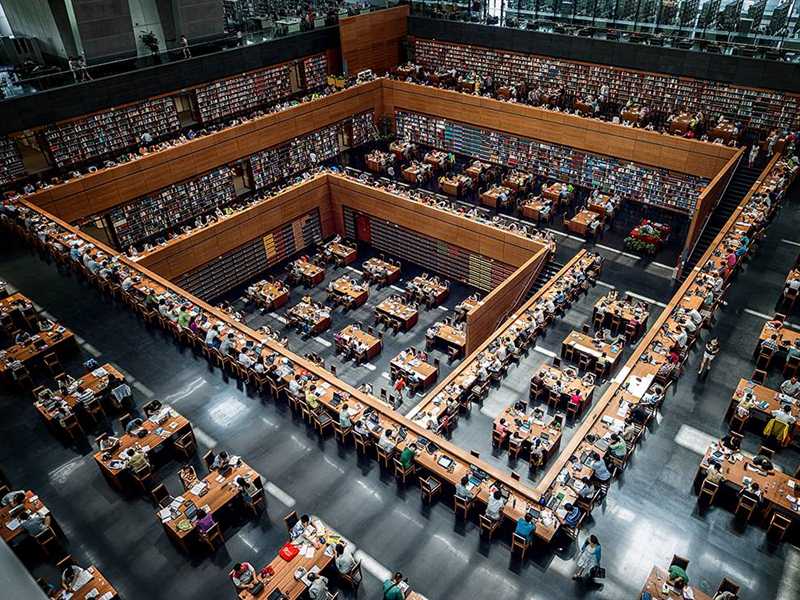
9. The National Library of China 
National Library of China
The National Library of China (NLC) in Beijing is the national library of the People's Republic of China. With a collection of over 33,78 million items, it is the largest library in Asia and one of the largest in the world. It holds the largest collections of Chinese literature and historical documents in the world. It was founded on 9 September 1909 by the government of the Qing dynasty. Visitors per year 5.2 million.

10. The Royal Library 
 Royal Library
The Royal Library in Copenhagen, Denmark, is the national library of Denmark and the university library of the University of Copenhagen. It is the largest library in the Nordic countries. It contains numerous historical treasures, and a copy of all works printed in Denmark since the 17th century are deposited there. The library holds nearly all known Danish printed works back to and including the first Danish book, printed in 1482. The library was founded in 1648 by King Frederik III, who contributed a comprehensive collection of European works. It was opened to the public in 1793. In 1989.  Cataloged Size (number of items) 35.1 million items. Digital collections: c. 551TB, Visitors per year 850,000.

So what you think about this list don't forget to mention :)

Thursday, April 7, 2016

Top 10 Largest Lake in the World

Top 10 Largest Lake in the World
Lake is an area of variable size filled with water, localized in a basin, that is surrounded by land, apart from any river or other outlet that serves to feed or drain the lake. Lakes lie on land and are not part of the ocean, and therefore are distinct from lagoons, and are also larger and deeper than ponds, though there are no official or scientific definitions. Lakes can be contrasted with rivers or streams, which are usually flowing. However most lakes are fed and drained by rivers and streams. Natural lakes are generally found in mountainous areas, rift zones, and areas with ongoing glaciation. Other lakes are found in endorheic basins or along the courses of mature rivers. Here top 10 largest lake in the word listed, Read on:

Top 10 Largest Lake in the World

1. The Caspian Sea (143,000 sq mi)   
Caspian Sea
The Caspian Sea is the largest enclosed inland body of water on Earth by area, variously classed as the world's largest lake or a full fledged sea. It is in an endorheic basin located between Europe and Asia. It is bounded to the northeast by Kazakhstan, to the northwest by Russia, to the west by Azerbaijan, to the south by Iran, and to the southeast by Turkmenistan. The Caspian Sea lies to the east of the Caucasus Mountains and to the west of the vast steppe of Central Asia. Its northern part, the Caspian Depression, is one of the lowest points on Earth. The ancient inhabitants of its coast perceived the Caspian Sea as an ocean, probably because of its saltiness and large size.  The sea has a surface area of 371,000 km2 (143,200 sq mi) (not including its detached lagoon of Garabogazköl Aylagy) and a volume of 78,200 km3 (18,800 cu mi). It has a salinity of approximately 1.2% (12 g/l), about a third of the salinity of most seawater.

2. The Lake Superior (31,700 sq mi)
Lake Superior
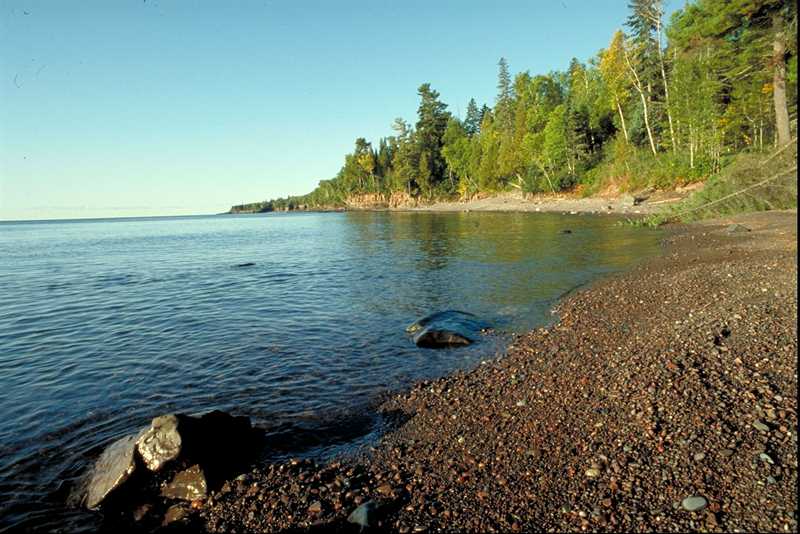
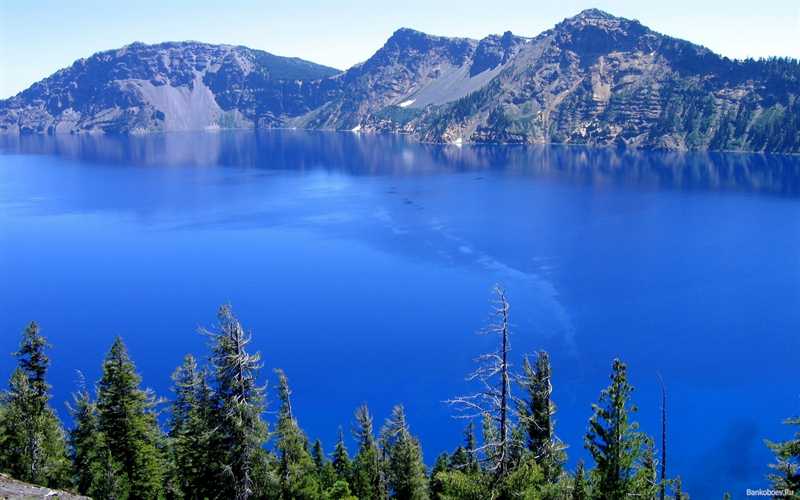
The Lake Superior is the largest of the Great Lakes of North America. The lake is shared by the province of Ontario to the north in Canada, the states of Minnesota to the west, Wisconsin and Michigan to the south in the United States. It is generally considered the largest freshwater lake in the world by surface area. It is the world's third-largest freshwater lake by volume and the largest by volume in North America. The rocks of Lake Superior's northern shore date back to the early history of the earth. During the Precambrian (between 4.5 billion and 540 million years ago) magma forcing its way to the surface created the intrusive granites of the Canadian Shield. Lake Superior has a surface area of 31,700 square miles (82,103 km2).  It has a maximum length of 350 statute miles (560 km; 300 nmi) and maximum breadth of 160 statute miles (257 km; 139 nmi).  Its average depth is 80.5 fathoms (483 ft; 147 m) with a maximum depth of 222.17 fathoms (1,333 ft; 406 m).

3. The Lake Victoria (26,828 sq mi)
Lake Victoria
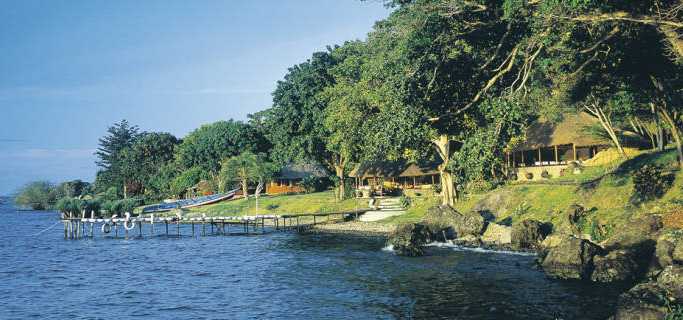
The Lake Victoria is one of the African Great Lakes. The lake was named after Queen Victoria by the explorer John Hanning Speke, the first Briton to document it. Speke accomplished this in 1858, while on an expedition with Richard Francis Burton to locate the source of the Nile River. With a surface area of 68,800 km2 (26,600 sq mi), Lake Victoria is Africa's largest lake by area and the largest tropical lake in the world. Lake Victoria is the world's second largest fresh water lake by surface area, after Lake Superior in North America. In terms of volume, Lake Victoria is the world's ninth largest continental lake, containing about 2,750 cubic kilometres (2.23×10⁹ acre·ft) of water. Lake Victoria occupies a shallow depression in Africa and has a maximum depth of 84 m (276 ft) and an average depth of 40 m (130 ft). Its catchment area covers 184,000 km2 (71,000 sq mi). The lake has a shoreline of 4,828 km (3,000 mi), with islands constituting 3.7 percent of this length.

4. The Lake Huron (23,000 sq mi)
Lake Huron
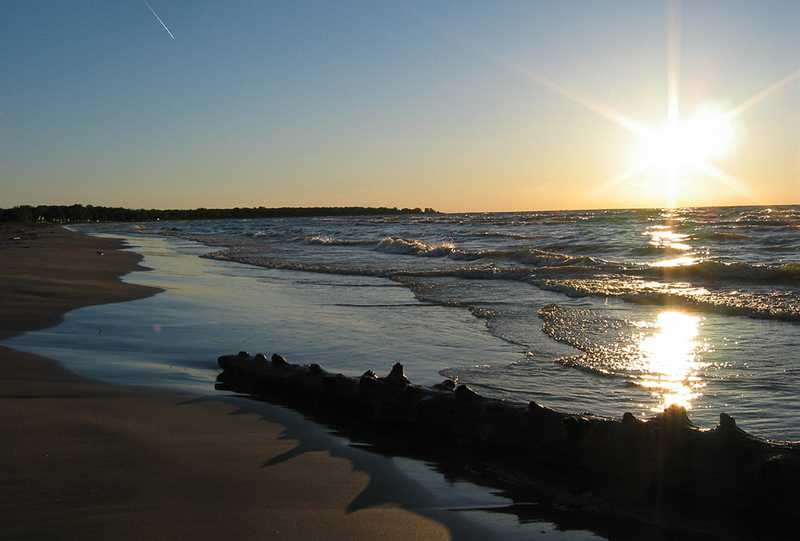
The Lake Huron is one of the five Great Lakes of North America. It is shared on the east by the Canadian province of Ontario and on the west by the state of Michigan in the United States. The northern parts of the lake include the North Channel and Georgian Bay. The main inlet is the St. Marys River and the main outlet is the St. Clair. By surface area, Lake Huron is the second-largest of the Great Lakes, with a surface area of 23,000 square miles (59,600 km2) making it the third-largest fresh water lake on Earth (and the fourth-largest lake, if the Caspian Sea is counted as a lake). By volume however, Lake Huron is only the third largest of the Great Lakes, being surpassed by Lake Michigan and Lake Superior. The surface of Lake Huron is 577 feet (176 m) above sea level. The lake's average depth is 32 fathoms 3 feet (195 ft; 59 m), while the maximum depth is 125 fathoms (750 ft; 229 m). It has a length of 206 statute miles (332 km; 179 nmi) and a greatest breadth of 183 statute miles (295 km; 159 nmi).

5. The Lake Michigan (22,000 sq mi)
Lake Michigan
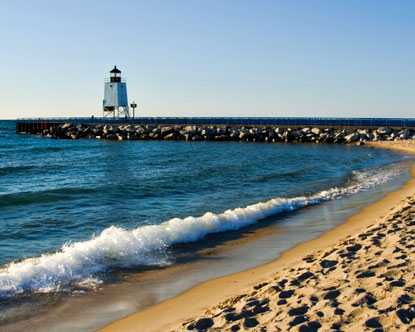
The Lake Michigan is one of the five Great Lakes of North America and the only one located entirely within the United States. The other four Great Lakes are shared by the U.S. and Canada. It is the second-largest of the Great Lakes by volume and the 3rd-largest by surface area. To the east, its basin is conjoined with that of Lake Huron through the wide Straits of Mackinac, giving it the same surface elevation as its easterly counterpart; the two are technically a single lake. Lake Michigan is shared, from west to east, by the U.S. states of Wisconsin, Illinois, Indiana, and Michigan. Lake Michigan has a surface area of 22,400 square miles (58,000 km2), making it the largest lake entirely within one country by surface area, and the fifth-largest lake in the world. It is 307 miles (494 km) long by 118 miles (190 km) wide with a shoreline 1,640 miles (2,640 km) long. The lake's average depth is 46 fathoms 3 feet (279 ft; 85 m), while its greatest depth is 153 fathoms 5 feet (923 ft; 281 m)

6. The Lake Tanganyika (12,700 sq mi)
Lake Tanganyika
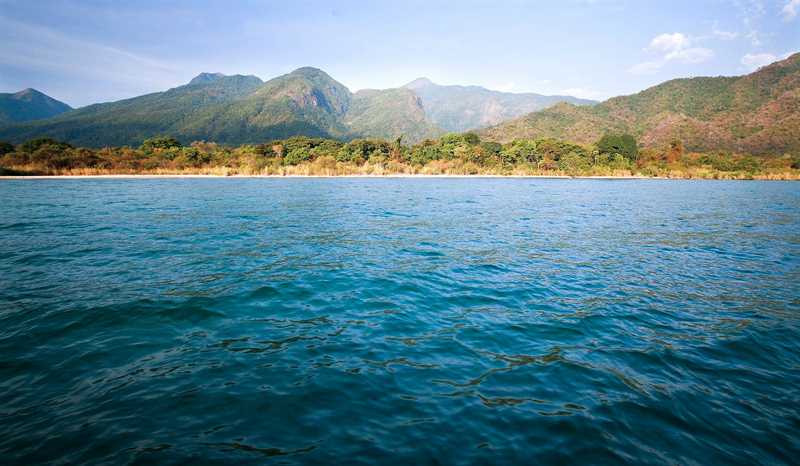
The Lake Tanganyika is an African Great Lake. It is estimated to be the second largest freshwater lake in the world by volume, and the second deepest. The lake is divided among four countries – Tanzania, Democratic Republic of the Congo, Burundi, and Zambia, with Tanzania (46%) and DRC (40%) possessing the majority of the lake. The water flows into the Congo River system and ultimately into the Atlantic Ocean.  It is the largest rift lake in Africa and the second largest lake by volume in the world. It is the deepest lake in Africa and holds the greatest volume of fresh water, accounting for 18% of the world's available fresh water. It extends for 676 km (420 mi) in a general north-south direction and averages 50 km (31 mi) in width. The lake covers 32,900 km2 (12,700 sq mi), with a shoreline of 1,828 km (1,136 mi), a mean depth of 570 m (1,870 ft) and a maximum depth of 1,470 m (4,820 ft) (in the northern basin). It holds an estimated 18,900 cubic kilometres (4,500 cu mi). This is equivalent to about 16% of all fresh water on Earth. It has an average surface temperature of 25 °C (77 °F).

7. The Lake Baikal (12,200 sq mi)
Lake Baikal
The Lake Baikal is a rift lake in Russia, located in southern Siberia, between Irkutsk Oblast to the northwest and the Buryat Republic to the southeast. Lake Baikal is the largest freshwater lake by volume in the world, containing roughly 20% of the world's unfrozen surface fresh water.With a maximum depth of 1,642 m (5,387 ft), Baikal is the world's deepest lake. It is considered among the world's clearest lakes and is considered the world's oldest lake at 25 million years. It is the seventh-largest lake in the world by surface area. With 23,615.39 km3 (5,700 cu mi) of fresh water, it contains more water than all the North American Great Lakes combined. Like Lake Tanganyika, Lake Baikal was formed as an ancient rift valley, having the typical long crescent shape with a surface area of 31,722 km2 (12,248 sq mi). Baikal is home to thousands of species of plants and animals, many of which exist nowhere else in the world. The lake was declared a UNESCO World Heritage Site in 1996. The mean temperature varies from a winter minimum of −19 °C (−2 °F) to a summer maximum of 14 °C (57 °F).

8. The Great Bear Lake (12,000 sq mi)
Great Bear Lake
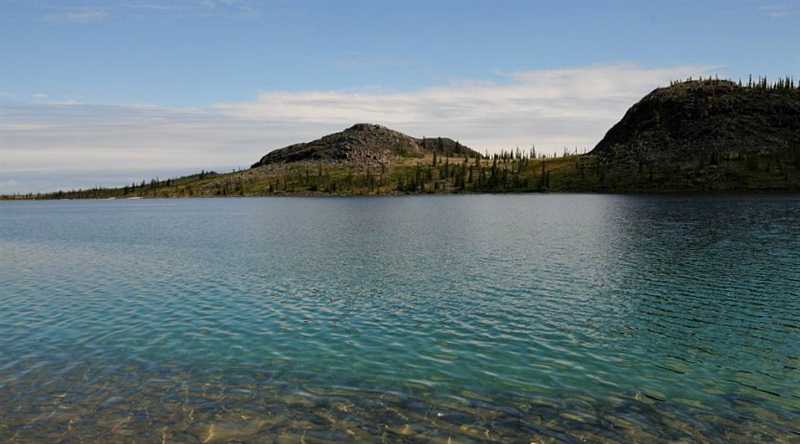
The Great Bear Lake is the largest lake entirely in Canada (Lake Superior and Lake Huron straddling the Canada-US border are larger), the fourth largest in North America, and the eighth largest in the world. The lake is in the Northwest Territories, on the Arctic Circle between 65 and 67 degrees of northern latitude and between 118 and 123 degrees western longitude, 156 m (512 ft) above sea level. The lake has a surface area of 31,153 km2 (12,028 sq mi) and a volume of 2,236 km3 (536 cu mi). Its maximum depth is 446 m (1,463 ft) and average depth 71.7 m (235 ft). The shoreline is 2,719 km (1,690 mi) and the catchment area of the lake is 114,717 km2 (44,292 sq mi). Great Bear Lake is covered with ice from late November to July.

9. The Lake Malawi (11,600 sq mi)
Lake Malawi
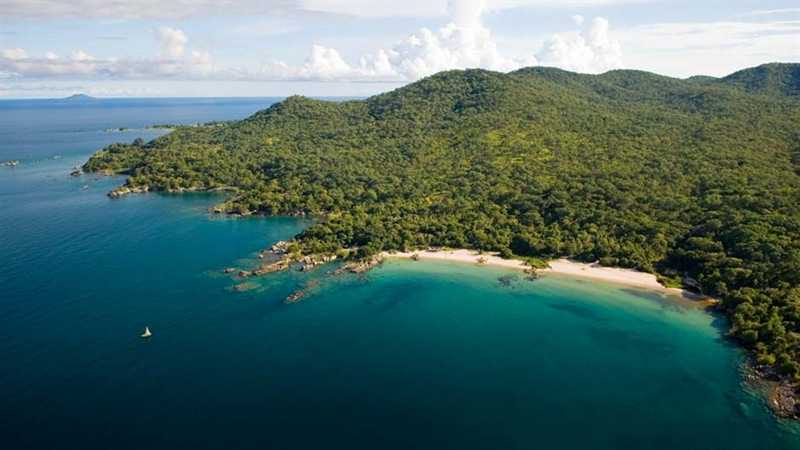
The Lake Malawi also known as Lake Nyasa in Tanzania and Lago Niassa in Mozambique, is an African Great Lake and the southernmost lake in the East African Rift system, located between Malawi, Mozambique and Tanzania. It is the ninth largest lake in the world and the third largest and second deepest lake in Africa. It is home to more species of fish than any other lake, including about 1000 species of cichlids. The Mozambique portion of the lake was officially declared a reserve by the Government of Mozambique on June 10, 2011, and in Malawi a portion of the lake is included in the Lake Malawi National Park.Lake Malawi is a meromictic lake. Lake Malawi is between 560 kilometres (350 mi) and 580 kilometres (360 mi) long, and about 75 kilometres (47 mi) wide at its widest point.

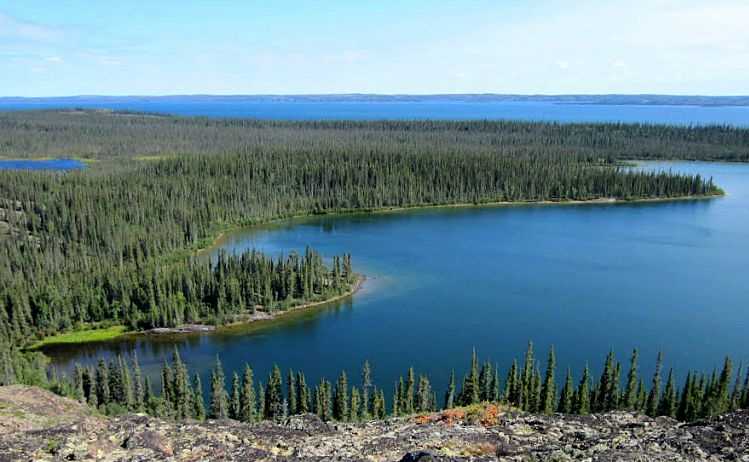
10. The Great Slave Lake (11,170 sq mi)
Great Slave Lake
 The Great Slave Lake is the second-largest lake in the Northwest Territories of Canada (after Great Bear Lake), the deepest lake in North America at 614 metres (336 fathoms; 2,014 ft), and the tenth-largest lake in the world. It is 469 km (291 mi) long and 20 to 203 km (12 to 126 mi) wide. It covers an area of 27,200 km2 (10,502 sq mi) in the southern part of the territory. Its given volume ranges from 1,070 km3 (260 cu mi) to 1,580 km3 (380 cu mi) and up to 2,088 km3 (501 cu mi) making it the 10th or 12th largest. Archaeological evidence has revealed several different periods of cultural history, including: Northern Plano Palaeoindian tradition (8,000 years before present), Shield Archaic (6,500 years), Arctic Small Tool Tradition (3,500 years), and the Taltheilei Shale Tradition (2,500 years before present).

So what you think about this list, don't forget to mention :)