Showing posts with label Highest. Show all posts

Monday, April 18, 2016

Top 10 Highest Airport in the World

Top 10 Highest Airport in the World
Large aircraft, primarily the wide body aircraft: (Airbus A300, A310, A330, A340, A350, A380; Boeing 747, 767, 777, 787; McDonnell Douglas DC-10, MD-11; Ilyushin Il-86, Il-96; the Lockheed L1011) will usually require at least 8,000 ft (2,438 m) at sea level and somewhat more at higher elevation airports. That's the stranded for elevation on an airport but there are a lot's of commercial airports have more elevation points than that, so here we listed Top 10 Highest Airport in the World, Read on:


Top 10 Highest Airport in the World

1. Daocheng Yading Airport
Daocheng Yading Airport is an airport serving Daocheng County in the Garzê Tibetan Autonomous Prefecture of Sichuan province, China. It is located in Sangdui Township, 50 kilometers north of the county seat and 130 kilometers from the Yading Nature Reserve. At 4,411 m (14,472 ft) above sea level, Daocheng Yading is the world's highest civilian airport, surpassing the previous record holder Qamdo Bamda Airport, in Tibet, at 4,334 m (14,219 ft)

2. Qamdo Bamda Airport
Qamdo Bamda Airport also known as Changdu Bangda Airport, is an airport serving Qamdo (Changdu), Tibet, China. It is located in the village of Bamda (Bangda). At an elevation of 4,334 m (14,219 ft) above sea level, Qamdo Airport was formerly the highest airport in the world. with an elevation of 4,411 m (14,472 ft), on 16 September 2013. It still has the longest publicly used paved runway in the world, at 5.5 km (3.4 mi)

3. Kangding Airport
Kangding Airport is an airport serving Kangding, the capital of Garzê Tibetan Autonomous Prefecture in western Sichuan Province, China. It is located 25 mi northwest of the city center. Situated at 4,280 m (14,042 ft) above sea level, Kangding Airport is the third highest airport in the world.

4. Ngari Gunsa Airport
Ngari Gunsa Airport is a dual-use military and civil airport serving the town of Shiquanhe in Ngari Prefecture, in the southwest of China's Tibet Autonomous Region near the Indian border.  Situated at 4,274 m (14,022 ft) above sea level, Gunsa Airport is the fourth highest airport in the world. Gunsa airport has a 4,500-meter runway. It is expected to handle 120,000 passengers by 2020.

5. El Alto International Airport
El Alto International Airport is an international airport located in the city of El Alto, Bolivia, 8 mi south-west of La Paz. It is the highest international airport (4,061 m/13,323 ft) and fifth highest commercial airport in the world.

6. Uyuni Airport
Uyuni Airport aka Joya Andina Airport, is a public use airport located slightly northwest of Uyuni, in the southwestern Potosí Department of Bolivia. Uyuni Airport features a 4,000 metres (13,000 ft) long and 45 metres (148 ft) wide paved runway, making it the airport with Bolivia's second longest runway. It's elevation is 3,954 m/12,972 ft.

7. Captain Nicolas Rojas Airport
Captain Nicolas Rojas Airport is an airport serving the city of Potosí, in the Tomás Frías province of the Potosí department of Bolivia. The airport resides at an elevation of 12,913 feet (3,936 m) above mean sea level. It has one runway designated 06/24 with an asphalt surface measuring 9,295 by 98 feet (2,833 m × 30 m).

8. Yushu Batang Airport
The Yushu Batang Airport is the airport serving Yushu City in Qinghai Province, China. It is located 18 kilometers to the south of the city center, Gyêgu, at the 3,890 meters elevation about the sea level, which makes it the highest civilian airport in Qinghai Province, and one of the highest in the world.

9. Inca Manco Cápac International Airport
Inca Manco Cápac International Airport known as Aeropuerto Internacional Inca Manco Cápac in Spanish, is an airport situated in the city of Juliaca, thirty minutes from the city of Puno at Titicaca Lake. It's elevation is 3,826 m/12,552 ft. The airport has one of the longest runways in Latin America.

10. Shigatse Peace Airport
Xigazê Peace Airport Xigazê Heping Airport, or Xigazê Air Base, is a dual-use military and civilian airport serving Xigazê, the second largest city in Tibet Autonomous Region, China. It is located in Jiangdang Township, 43 kilometers from Xigazê. Situated at an elevation of 3,782 metres (12,408 ft), it is one of the highest airports in the world.

So what you think about this list don't forget to mention :)

Thursday, April 14, 2016

Top 10 Highest Statues in the World

Top 10 Highest Statues in the World
A statue is a sculpture representing one or more people or animals, normally full length, as opposed to a bust, and at least close to life-size, or larger. A small statue, usually small enough to be picked up, is called a statuette or figurine. The most impressive statues around the world stands for honoring great personalities and important events in the history. Some of them have enough heights to become main attraction of the city. The following is a list of the top 10 highest statues in the world, considering only the figure itself, without any pedestal or plinth included in the measurement and sorted by height of the statue. Read On:

Top 10 Highest Statues in the World

1. Spring Temple Buddha (153 meters)
Spring Temple Buddha (153 meters)
The Spring Temple Buddha is a statue depicting Vairocana Buddha located in the Zhaocun township of Lushan County, Henan, China, built from 1997 to 2008. It is located within the Fodushan Scenic Area, close to National Freeway no. 311. At 128 m (420 ft), not including a 20 m (66 ft) lotus pedestal, it is the tallest statue in the world. When the 25 m (82 ft) pedestal/building it is placed upon is taken into account, the monument has a total height of 153 m (502 ft). As of October 2008, the hill on which the statue stands is being reshaped to form two further pedestals, the upper one being 15 m tall. The total height of the monument is now said to be 208 m (682 ft). The project as a whole was estimated to cost around $55 million, $18 million of which being spent on the statue. It was originally estimated to consist of 1,100 pieces of copper cast, with a total weight of 1,000 tonnes. Beneath the statue is a Buddhist monastery.

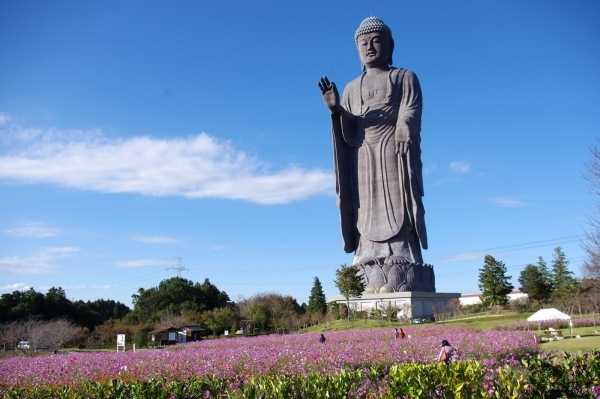
2. Ushiku Daibutsu (120 meters)
Ushiku Daibutsu (120 meters)
Ushiku Daibutsu is a statue located in Ushiku, Ibaraki Prefecture, Japan. Completed in 1993, it stands a total of 120 metres (390 ft) tall, including the 10 m (33 ft) base and 10m lotus platform. An elevator takes visitors up 85 m (279 ft) to an observation floor. The statue depicts Amitabha Buddha and is made of bronze. It is also known as Ushiku ARCADIA. It was built to commemorate the birth of Shinran, founder of the Jōdo Shinshū 浄土真宗 or "True Pure Land School" of Buddhism. Its Weight: 4,003 tonnes (8,825,000 lb. There are four different levels within the statue, visitors can reach the top by using the elevator. At first level visitors can hear beautiful music, the 2nd level completely dedicated for scriptural studies, third level filled with 30000 Buddha statues. From the top level visitors can watch the beautiful gardens within the surroundings of statue.

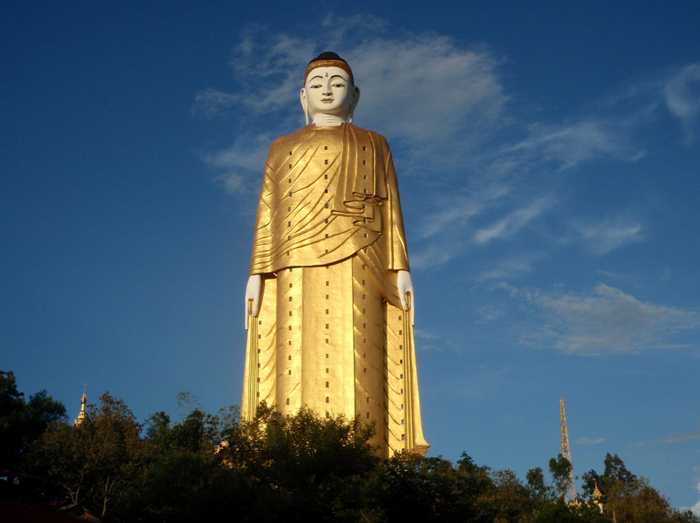
3. Laykyun Setkyar (116 meters)
Laykyun Setkyar (116 meters)
The Laykyun Sekkya Buddha is the third tallest statue in the world at 116 metres (381 ft). This statue of Gautama Buddha stands on a 13.5-metre (44 ft) throne located in the village of Khatakan Taung, near Monywa, Myanmar. Construction began in 1996 and it was completed on 21 February 2008. It was commissioned by the Chief Abbot Ven. Nãradã. There is also an elevator inside the statue for visitors to getting top for enjoying panoramic view of the city. Visitors can also see 89 meter lying Buddha next to Laykyun Setkyar statue.

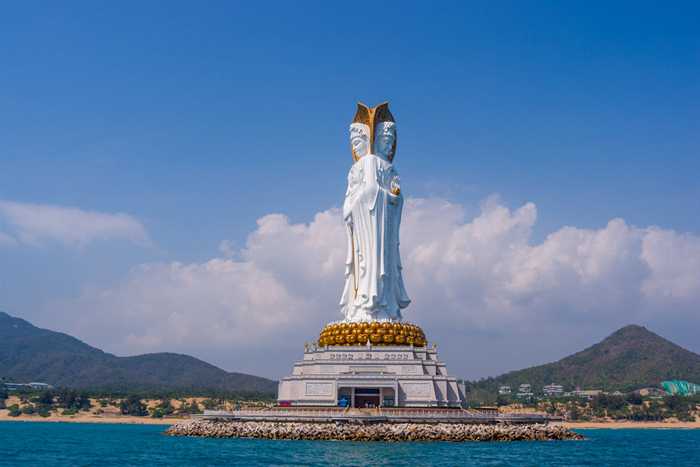
4. Guan Yin of the South Sea of Sanya (108 Meters)
Guan Yin of the South Sea of Sanya (108 Meters)
The Guanyin of the South Sea of Sanya is a 108-metre (354 ft) statue of the bodhisattva Avalokiteśvara , sited on the south coast of China's island province Hainan near the Nanshan Temple of Sanya. The statue has three aspects; one side faces inland and the other two face the South China Sea, to represent blessing and protection by Guanyin of China and the whole world. One aspect depicts Guanyin cradling a sutra in the left hand and gesturing the Vitarka Mudra with the right, the second with her palms crossed, holding a string of prayer beads, and the third holding a lotus. This is currently the fourth tallest statue in the world and the tallest statue of Guanyin in the world.  The statue took six years to build and was enshrined on April 24, 2005, with the participation of 108 eminent monks from various Buddhist groups in Taiwan, Hong Kong, Macao and Mainland China, and tens of thousands of pilgrims. The delegation also included monks from the Theravada and Vajrayana traditions.

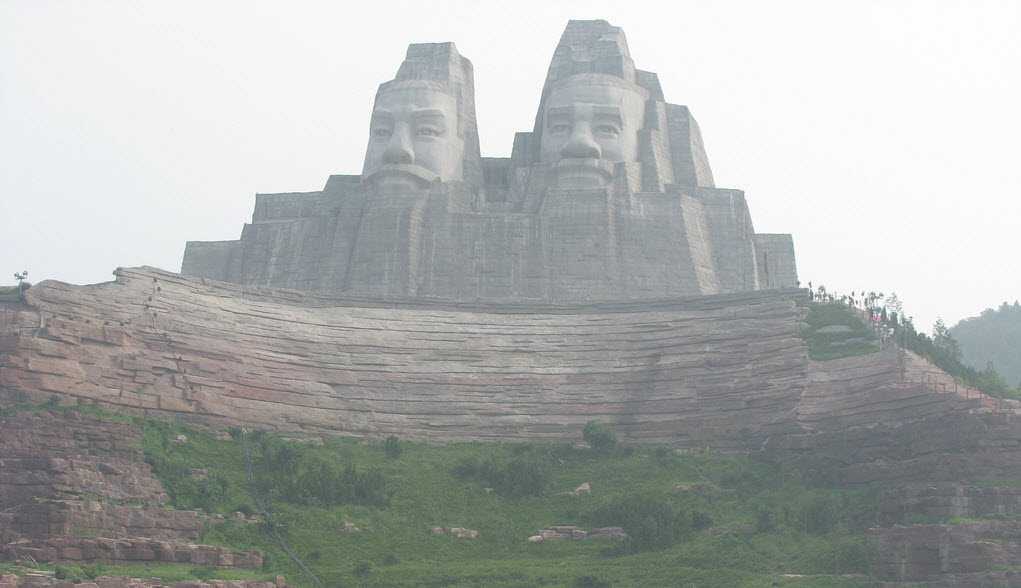
5. Emperors Yan and Huang (106 meters)
Emperors Yan and Huang (106 meters)
The sculptures of the Emperors Yan and Huang are the fifth tallest statues in the world at 106 meters. They depict two of the earliest Chinese emperors, Yan Di and Huang Di. The construction lasted 20 years and was completed in 2007. They are located in Zhengzhou, the capital of Henan province, People's Republic of China. According to experts, the statues commemorate politics and the economy. Government spent $22.5 million for the construction of these statues. The eyes of these statues are 3 meters wide and nose have length of 6 meter.

6. Sendai Daikannon (100 meters)
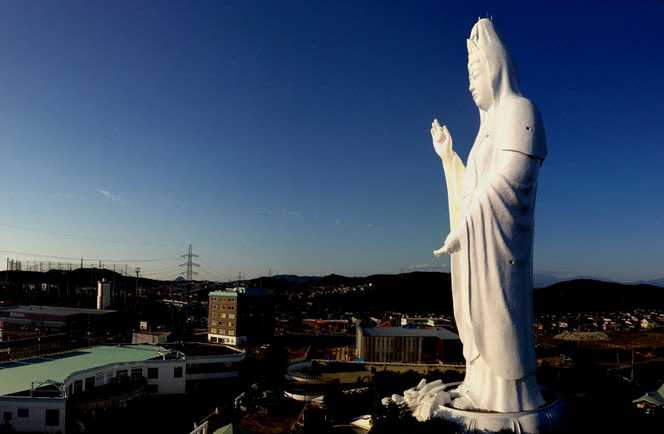
Sendai Daikannon (100 meters)
Sendai Daikannon, located in Sendai, Japan, is the sixth tallest statue in the world at 100 meters (328 feet). An elevator takes tourists to the top of the statue, which depicts the Japanese Buddhist Bodhisattva Kannon. Sendai Daikannon holding a jewel within it’s right hand and a water hand in left hand, to our the water of wisdom. Through the elevators tourist can reach at the top of the statue and can view entire city.

7. Guishan Guanyin of the Thousand Hands and Eyes (99 meters)
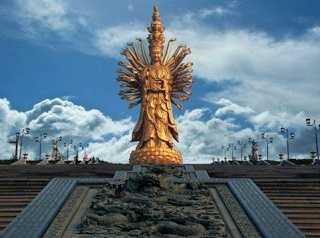
Guishan Guanyin of the Thousand Hands and Eyes (99 meters)
Guishan Guanyin of the Thousand Hands and Eyes is the fourth tallest statue in China, and the seventh tallest in the world. This gilded bronze monument depicting Avalokitesvara stands 99 m (325 ft) tall, and is located in Weishan, Changsha, Hunan, People's Republic of China. The Ningshan County Government, with the help of local business and religious organizations, invested 260 million yuan to complete its construction in 2009.

8. Peter the Great Statue (98 meters)
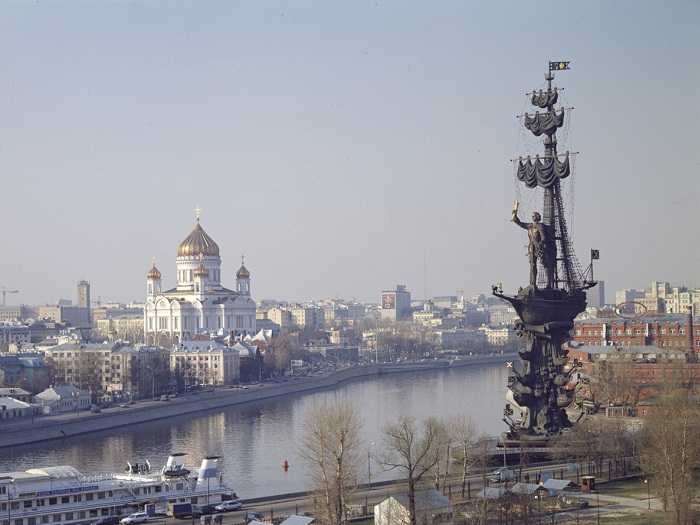
Peter the Great Statue (98 meters)
The Peter the Great Statue is a 98 meter high monument to Peter the Great, located at the western confluence of the Moskva River and the Vodootvodny Canal in central Moscow. It was designed by the Georgian designer Zurab Tsereteli to commemorate 300 years of the Russian Navy, which Peter the Great established. It was erected in 1997 and is the eighth tallest statue in the world. It weighs around 1,000 tons and contains 600 tons of stainless steel, bronze and copper.

9. Great Buddha of Thailand (92 meters)
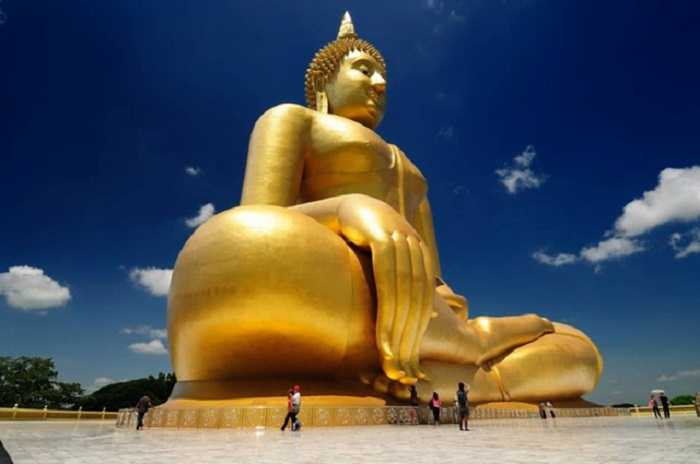
. Great Buddha of Thailand (92 meters)
The Great Buddha of Thailand, also known as The Big Buddha, The Big Buddha of Thailand, Phra Buddha Maha Nawamin, and Mahaminh Sakayamunee Visejchaicharn, is the tallest statue in Thailand, and the ninth tallest in the world.  Located in the Wat Muang Monastery in Ang Thong province, this statue stands 92 m (300 ft) high, and is 63 m (210 ft) wide. Construction commenced in 1990, and was completed in 2008. It is painted gold and made of concrete.

10. Grand Buddha at Lingshan (88 meters)
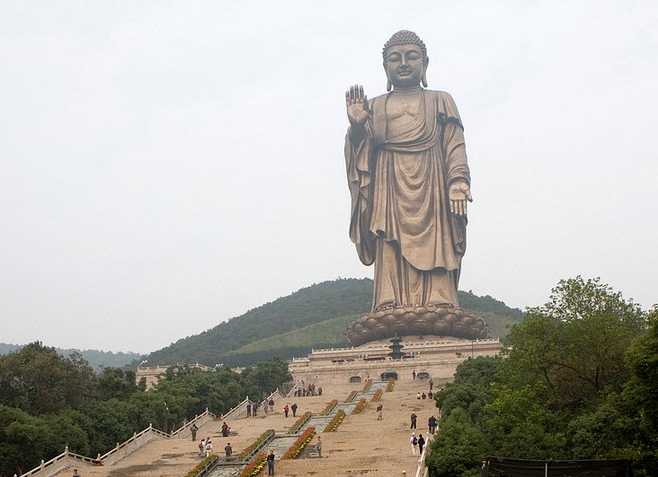
Grand Buddha at Lingshan (88 meters)
The Grand Buddha is located at the south of the Longshan Mountain, near Mashan, town of Wuxi, Jiangsu Province, People's Republic of China. It is one of the largest Buddha statues in China and also in the world.  At more than 88 metres high, the Grand Buddha at Ling Shan is a bronze Amitabha standing Buddha outdoor, weighing over 700 tons. It was completed in the end of 1996.  In 2008, a "Five-signets" Palace and a Brahma Palace were built south-east of the grand buddha statue.

So what you think about this list; don't forget to mention :)

Thursday, April 7, 2016

Top 10 Highest Mountain in the World

Top 10 Highest Mountain in the World
Mountain is a large land form that stretches above the surrounding land in a limited area, usually in the form of a peak. Mountains are formed through tectonic forces or volcanism. These forces can locally raise the surface of the earth. Mountains erode slowly through the action of rivers, weather conditions, and glaciers. A few mountains are isolated summits, but most occur in huge mountain ranges.  High elevations on mountains produce colder climates than at sea level. The highest mountain on Earth is Mount Everest in the Himalayas of Asia, whose summit is 8,850 m (29,035 ft) above mean sea level. Let's see Top 10 Highest Mountain in the World. Read on:

Top 10 Highest Mountain in the World

1. The Mount Everest (29,029 ft)
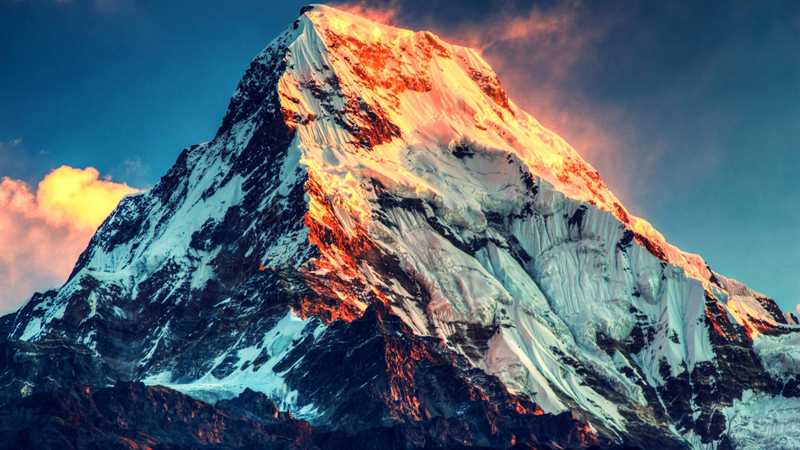
Everest
The Mount Everest, also known in Nepal as Sagarmāthā and in Tibet as Chomolungma, is Earth's highest mountain. It is located in the Mahalangur mountain range in Nepal and Tibet. Its peak is 8,848 metres (29,029 ft) above sea level. The international border between China (Tibet Autonomous Region) and Nepal runs across Everest's precise summit point. In 1856, the Great Trigonometrical Survey of India established the first published height of Everest, then known as Peak XV, at 8,840 m (29,002 ft). The current official height of 8,848 m (29,029 ft) as recognized by China and Nepal was established by a 1955 Indian survey and subsequently confirmed by a Chinese survey in 1975. In 1865, Everest was given its official English name by the Royal Geographical Society upon a recommendation by Andrew Waugh, the British Surveyor General of India. Waugh named the mountain after his predecessor in the post, Sir George Everest, arguing that there were many local names, against the opinion of Everest. After years of dreaming about it and seven weeks of climbing, New Zealander Edmund Hillary and Nepalese Tenzing Norgay reached the top of Mount Everest, the highest mountain in the world, at 11:30 a.m. on May 29, 1953. They were the first people to ever reach the summit of Mount Everest.

2. The K2 (28,251 ft)
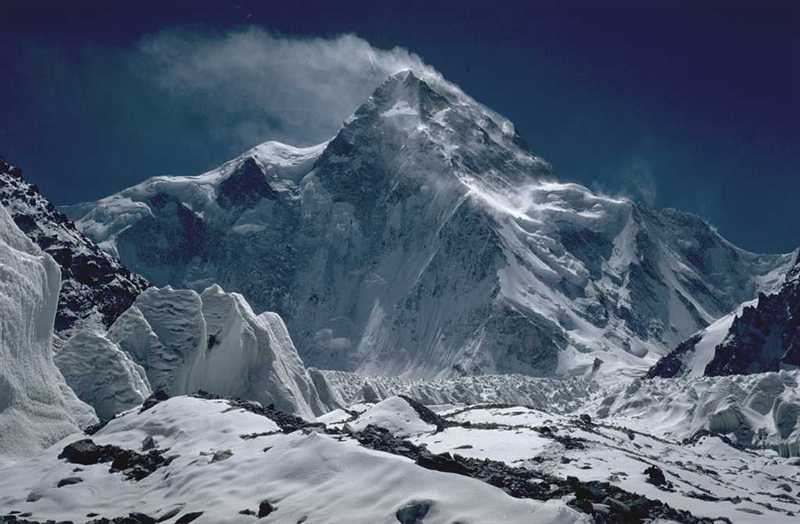
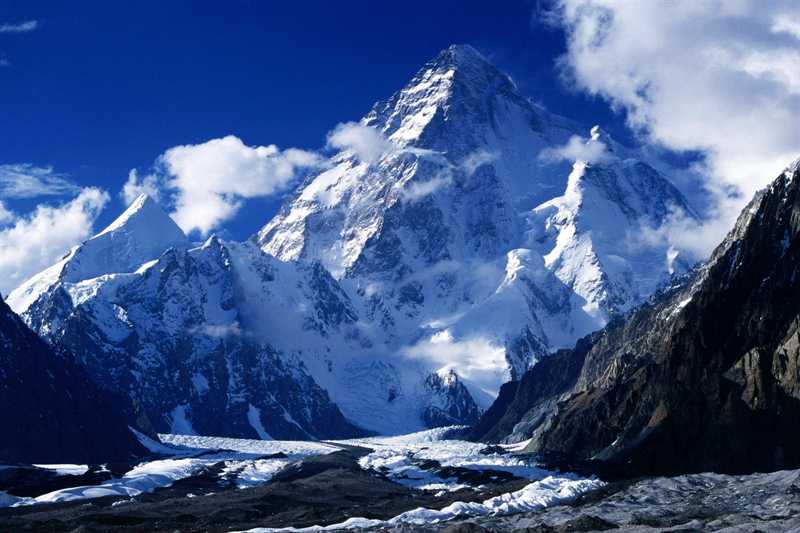
K2
The K2, also known as Chhogori/Qogir, Ketu/Kechu, and Mount Godwin-Austen is the second highest mountain in the world, after Mount Everest, at 8,611 metres (28,251 ft) above sea level. It is located on the China-Pakistan border between Baltistan, in the Gilgit–Baltistan region of northern Pakistan, and the Taxkorgan Tajik Autonomous County of Xinjiang, China. K2 is the highest point of the Karakoram range and the highest point in Pakistan. K2 is known as the Savage Mountain due to the extreme difficulty of ascent. It has the second-highest fatality rate among the eight thousanders. With around 300 successful summits and 80 fatalities, about one person dies on the mountain for every four who summit. The name K2 is derived from the notation used by the Great Trigonometric Survey of British India. Thomas Montgomerie made the first survey of the Karakoram from Mount Haramukh, some 210 km (130 miles) to the south, and sketched the two most prominent peaks, labeling them K1 and K2. An Italian expedition finally succeeded in ascending to the summit of K2 via the Abruzzi Spur on 31 July 1954. The expedition was led by Ardito Desio,

3. The Kangchenjunga (28,169 ft)
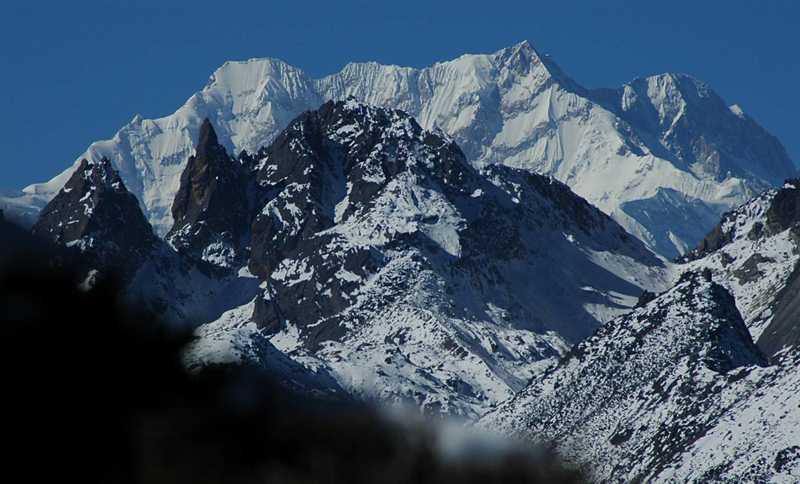
Kangchenjunga
The Kangchenjunga is the third highest mountain in the world, and lies partly in Nepal and partly in Sikkim, India. It rises with an elevation of 8,586 m (28,169 ft) in a section of the Himalayas called Kangchenjunga Himal that is limited in the west by the Tamur River, in the north by the Lhonak Chu and Jongsang La, and in the east by the Teesta River. Kangchenjunga is the second highest peak of the Himalaya after Mount Everest. The main peak of Kangchenjunga is the highest mountain in India and the second highest in Nepal. Until 1852, Kangchenjunga was assumed to be the highest mountain in the world, but calculations based on various readings and measurements made by the Great Trigonometrical Survey of India in 1849 came to the conclusion that Mount Everest, it was officially announced in 1856 that Kangchenjunga is the third highest mountain. Kangchenjunga was first climbed on 25 May 1955 by Joe Brown and George Band, who were part of a British expedition.

4. The Lhotse (27,940 ft)
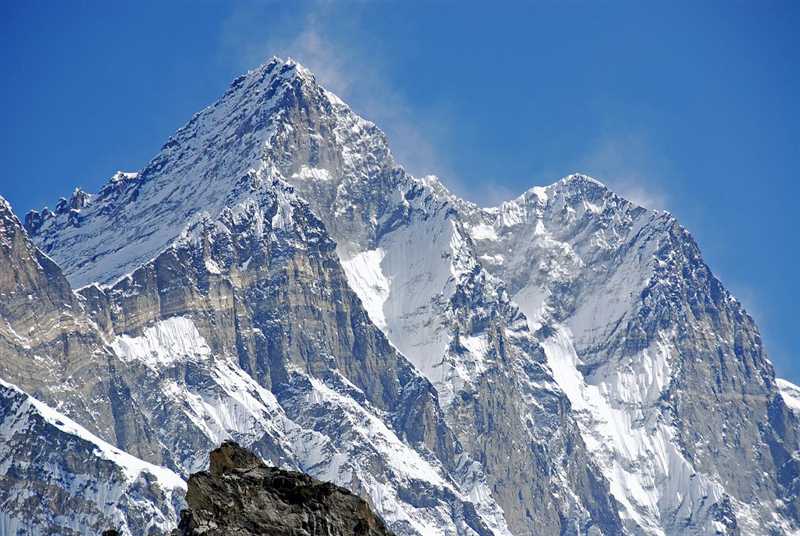
Lhotse
The Lhotse is the fourth highest mountain in the world at 8,516 metres (27,940 ft), after Mount Everest, K2, and Kangchenjunga. Part of the Everest massif, Lhotse is connected to the latter peak via the South Col. Lhotse means “South Peak” in Tibetan. In addition to the main summit at 8,516 metres (27,940 ft) above sea level, the mountain comprises the smaller peaks Lhotse Middle (East) at 8,414 m (27,605 ft), and Lhotse Shar at 8,383 m (27,503 ft). The summit is on the border between Tibet (China) and the Khumbu region of Nepal. First ascent was in May 18, 1956 Fritz Luchsinger, Ernst Reiss (First winter ascent 31 December 1988 Krzysztof Wielicki). The western flank of Lhotse is known as the Lhotse Face. Any climber bound for the South Col on Everest must climb this 1,125 m (3,690 ft) wall of glacial blue ice. This face rises at 40 and 50 degree pitches with the occasional 80 degree bulges.

5. The Makalu (27,838 ft)
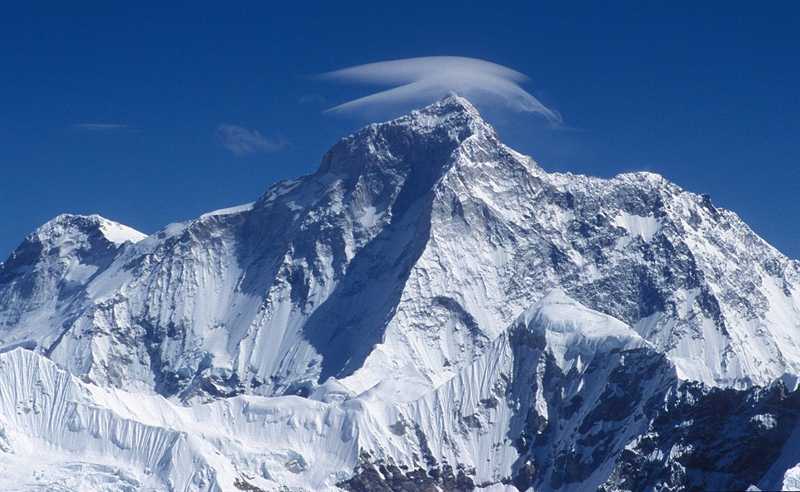
Makalu
The Makalu is the fifth highest mountain in the world at 8,485 metres (27,838 ft). It is located in the Mahalangur Himalayas 19 km (12 mi) southeast of Mount Everest, on the border between Nepal and China. One of the eight-thousanders, Makalu is an isolated peak whose shape is a four-sided pyramid.  Makalu has two notable subsidiary peaks. Kangchungtse, or Makalu II (7,678 m) lies about 3 km (2 mi) north-northwest of the main summit. Rising about 5 km (3.1 mi) north-northeast of the main summit across a broad plateau, and connected to Kangchungtse by a narrow, 7,200 m saddle, is Chomo Lonzo (7,804 m). Makalu was first climbed on May 15, 1955 by Lionel Terray and Jean Couzy of a French expedition led by Jean Franco. Franco, G. Magnone and Sardar Gyaltsen Norbu summitted the next day, followed by Bouvier, S. Coupe, Leroux and A Vialatte on the 17th.

6. The Cho Oyu (26,906 ft) 
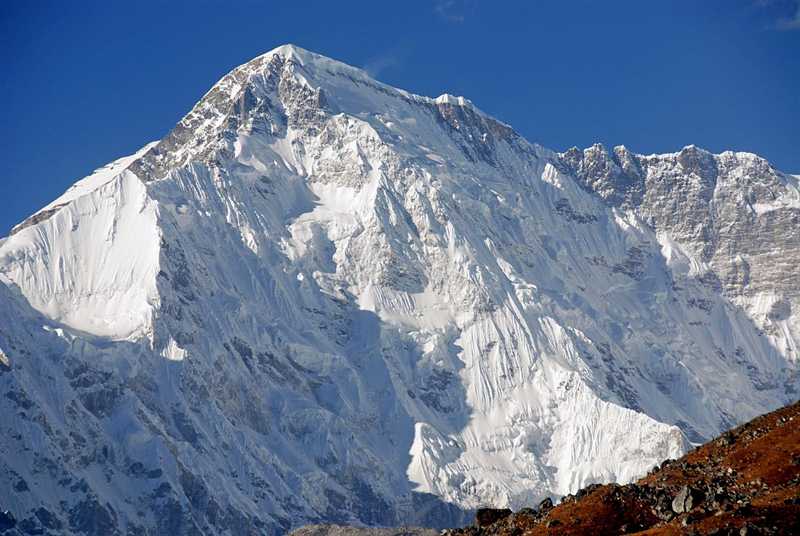
Cho Oyu
The Cho Oyu is the sixth highest mountain in the world at 8,201 metres (26,906 ft) above sea level. Cho Oyu means "Turquoise Goddess" in Tibetan. The mountain is the westernmost major peak of the Khumbu sub-section of the Mahalangur Himalaya 20 km west of Mount Everest. The mountain stands on the China-Nepal border. The mountain was first climbed on October 19, 1954, via the north-west ridge by Herbert Tichy, Joseph Jöchler and Sherpa Pasang Dawa Lama of an Austrian expedition. Cho Oyu was the fifth 8000 metre peak to be climbed, after Annapurna in June 1950, Mount Everest in May 1953, Nanga Parbat in July 1953 and K2 in July 1954.

7. The Dhaulagiri (26,795 ft)
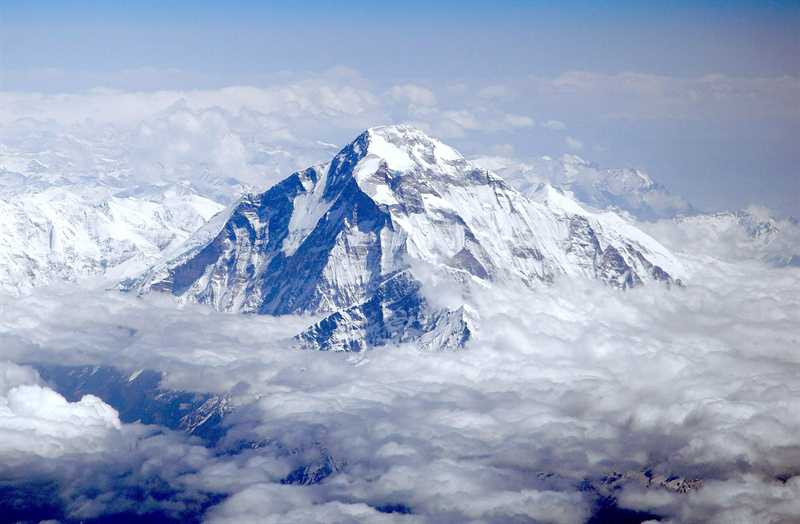
Dhaulagiri
The Dhaulagiri massif in Nepal extends 120 km (70 mi) from the Kaligandaki River west to the Bheri. This massif is bounded on the north and southwest by tributaries of the Bheri River and on the southeast by Myagdi Khola. Looking north from the plains of India, most 8,000-metre peaks are obscured by nearer mountains. Dhaulagiri I is the seventh highest mountain in the world at 8,167 metres (26,795 ft) above sea level. It was first climbed on May 13, 1960 by a Swiss/Austrian/Nepali expedition Kurt Diemberger, A. Schelbert, E. Forrer, Nawang Dorje, Nyima Dorje (First winter ascent 21 January 1985 Jerzy Kukuczka and Andrzej Czok).

8. The Manaslu (26,781 ft)
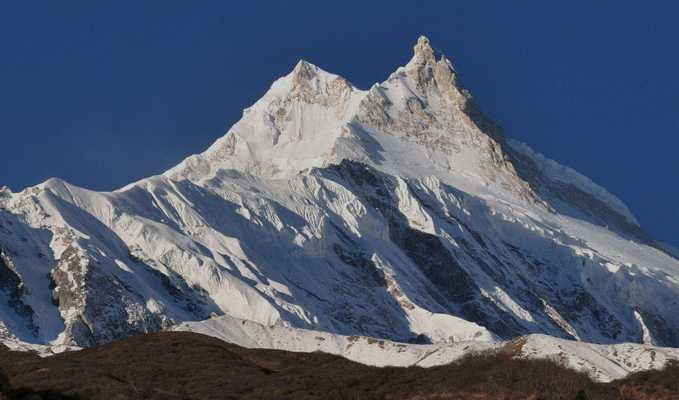
Manaslu
The Manaslu is the eighth highest mountain in the world at 8,163 metres (26,781 ft) above sea level. It is located in the Mansiri Himal, part of the Nepalese Himalayas, in the west-central part of Nepal. Its name, which means "mountain of the spirit", comes from the Sanskrit word manasa, meaning "intellect" or "soul". Manaslu was first climbed on May 9, 1956 by Toshio Imanishi and Gyalzen Norbu, members of a Japanese expedition. It is said that "just as the British consider Everest their mountain, Manaslu has always been a Japanese mountain". Manaslu at 8,156 metres (26,759 ft) above mean sea level  is the highest peak in the Lamjung District and is located about forty miles east of Annapurna. The mountain's long ridges and valley glaciers offer feasible approaches from all directions.

9. The Nanga Parbat (26,660 ft)
Nanga Parbat
The Nanga Parbat is the ninth highest mountain in the world at 8,126 metres (26,660 ft) above sea level. It is the western anchor of the Himalayas around which the Indus river skirts into the plains of Pakistan. It is located in the Gilgit-Baltistan region of the Pakistan and is locally known as 'Deo Mir'. Nanga Parbat is one of the eight-thousanders, with a summit elevation of 8,126 metres (26,660 ft).[3] An immense, dramatic peak rising far above its surrounding terrain, Nanga Parbat is also a notoriously difficult climb. Numerous mountaineering deaths in the mid and early 20th century lent it the nickname "killer mountain". Nanga Parbat was first climbed, via the Rakhiot Flank (East Ridge), on July 3, 1953 by Austrian climber Hermann Buhl, a member of a German-Austrian team.

10. The Annapurna I (26,545 ft) 
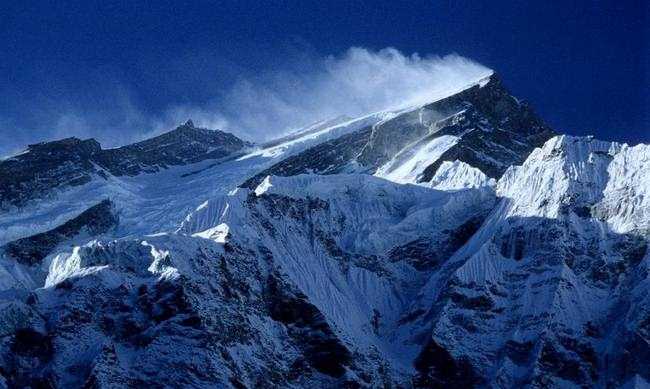
Annapurna I
The Annapurna I is a mountain and part of the Annapurna massif in the Himalayas in north-central Nepal that includes one peak over 8,000 metres (26,000 ft), thirteen peaks over 7,000 metres (23,000 ft), and sixteen more over 6,000 metres (20,000 ft). The massif is 55 kilometres (34 mi) long, and is bounded by the Kali Gandaki Gorge on the west, the Marshyangdi River on the north and east, and by Pokhara Valley on the south. At the western end the massif encloses a high basin called the Annapurna Sanctuary. Annapurna I Main is the tenth highest mountain in the world at 8,091 metres (26,545 ft) above sea level. Annapurna peaks are among the world's most dangerous mountains to climb, although in more recent history, using only figures from 1990 and after, Kangchenjunga has a higher fatality rate. First ascent was in 3 June 1950 Maurice Herzog and Louis Lachenal.

So what you think about this list, don't forget to mention :)